



THIS IS STILL ONE OF THE MOST HEARTBREAKING STORIES I’VE EVER KNOWN. 💔
Laika’s story begins not in the stars, but on the streets of Moscow. She was an ordinary stray dog, one among thousands wandering through the post-war Soviet city in the 1950s. Small, scrappy, and resilient, she had no name, no family, no one to protect her from the biting cold of Russian winters. Yet fate had something extraordinary in store for her—something that would make her one of the most famous dogs in history.
In 1957, the Soviet Union was locked in a fierce competition with the United States. The Cold War had become not only a clash of politics and ideologies, but also a race into the unknown frontier of space. Just weeks earlier, the Soviets had shocked the world by launchingSputnik 1, the first man-made satellite to orbit the Earth. But that achievement was not enough. Soviet leader Nikita Khrushchev wanted to cement their dominance in the space race with another mission—one that would prove that life could survive in orbit. The task: to send a living being around the Earth.
But there was one problem. Technology at the time had no way of bringing a spacecraft safely back to Earth. This mission was destined to be one-way. Whoever went up would not return. The Soviets chose a dog.
Laika was selected after a careful process. Scientists believed stray dogs, who had endured harsh conditions on the streets, would be more adaptable to the stresses of space travel. Laika, a small female dog weighing just 6 kilograms, with a calm temperament and a trusting nature, was chosen. She was trained alongside other dogs, learning to endure cramped spaces, loud noises, and simulated rocket launches. Her gentle spirit made her the ideal candidate. She did not know that her mission was a death sentence.
On November 3, 1957, just one month after Sputnik 1, Sputnik 2 was launched carrying Laika aboard. The spacecraft was hastily constructed in less than four weeks, pressured by political demands rather than careful engineering. Unlike later space capsules,Sputnik 2 was not designed for re-entry. There were no parachutes, no heat shields, no way to bring Laika back to Earth alive.
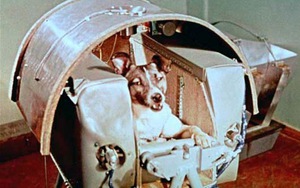
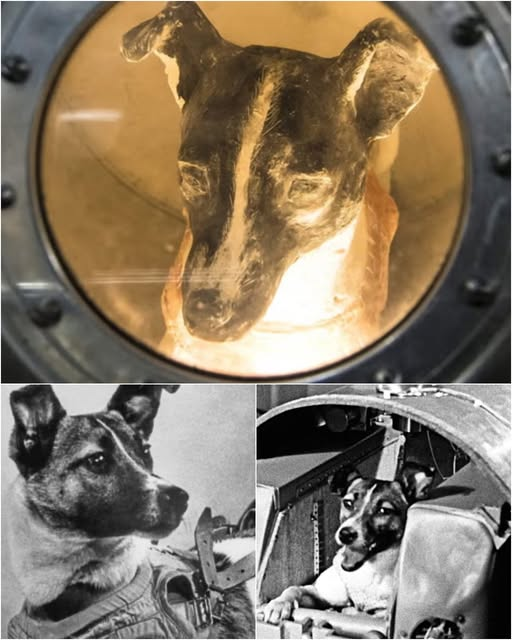
When the rocket roared into the sky, Laika was strapped inside a small metal cabin. Instruments monitored her heartbeat, breathing, and movement. For a brief moment, she became the most famous dog in the world—the first living being to orbit the Earth. The world looked up at the stars, knowing that somewhere above, a little dog circled the planet.
But the truth was far more tragic. For decades, Soviet officials claimed that Laika survived for several days before being euthanized with poisoned food to spare her suffering. The reality, revealed years later, was far more painful. Due to overheating and stress, Laika died only a few hours into the flight. Alone, in silence, drifting high above the Earth, she suffered and then was gone.
Her sacrifice was not in vain. The mission provided critical data about the survival of living organisms in space. The knowledge gained from Laika’s short journey helped pave the way for future human space travel, eventually leading to Yuri Gagarin’s historic flight in 1961 and the Apollo missions that took humans to the Moon. But it came at a terrible cost—a cost borne by a creature who never chose to be part of humanity’s ambition.
Laika’s story is not just about science. It is about the ethical dilemmas of progress. Even at the time, some scientists and animal lovers questioned the morality of sending a dog on a mission with no hope of return. Others defended it, arguing that the survival of humans in space had to be tested, no matter the cost. Laika herself could not speak, could not refuse, could not understand. She was both a pioneer and a victim.
Over the years, Laika has come to symbolize more than just a milestone in space exploration. She represents innocence sacrificed for ambition, the voiceless paying the price for human advancement. She reminds us that progress often comes tangled with tragedy, and that every leap forward carries questions of morality and responsibility.
Today, Laika is remembered with monuments, books, songs, and art dedicated to her memory. A small statue of her stands at a military research facility in Moscow, showing her perched atop a rocket, forever gazing skyward. Schoolchildren in Russia learn her name as part of their history lessons. Across the world, animal lovers still mourn her, seeing her not just as a dog, but as a soul who deserved more than what history gave her.
There is a haunting image that lingers when we think of Laika: a little dog, alone in the vastness of space, her heart racing, her breath short, surrounded not by family or warmth but by cold metal and silence. And yet, within that image is also something extraordinary. Laika carried humanity’s dreams beyond Earth for the very first time. Her journey proved that life could leave the planet. In a way, she opened the door for all who followed—astronauts, satellites, explorers, dreamers.
But even as we celebrate space exploration, Laika reminds us of the responsibility that comes with discovery. Scientific progress should not come at the cost of compassion. Her life and death force us to ask: what price are we willing to pay for ambition? Where should humanity draw the line between achievement and ethics?
For many, Laika will always be remembered not just as the first traveler among the stars, but as a symbol of innocence lost to human desire for greatness. She was not a soldier, not a volunteer, not even aware of the role she was destined to play. She was just a stray dog, plucked from the streets, who became a legend in the sky.
More than sixty years later, her story still breaks hearts. Laika’s name lives on, carried by history, by compassion, and by the enduring memory of a small dog who orbited Earth but never came home.
Laika was more than a passenger. She was the face of courage, unwittingly carrying humanity into a new era. Her story is both triumph and tragedy, reminding us that behind every great achievement are sacrifices that must never be forgotten.
And so, as we look at the stars today, perhaps we can remember her not just as a scientific experiment, but as Laika—the little stray dog who touched the sky, and whose memory still teaches us about ambition, compassion, and the cost of progress.