
Tamarack was barely more than a cub when disaster struck. The Northern California wildfire tore through the forest, consuming everything in its path—trees, brush, and the delicate habitats of countless animals. For Tamarack, it was a terrifying baptism by fire. He ran blindly through the smoke, his small paws blistered, his fur scorched, and the world around him a blur of orange and ash. Alone, frightened, and injured, the tiny bear faced a peril that no cub should ever endure.
Rescue came in the form of a team of wildlife caretakers, who found him huddled under a burnt tree, shivering and weak. They immediately brought him to a wildlife care facility, a place where survival was possible but freedom uncertain. Tamarack’s burns were treated, his tiny body fed and hydrated, and slowly, he began to regain strength. But even as he recovered physically, there was an unspoken question looming: what would become of him once healed? Could a cub who had known only the forest ever truly belong in captivity?
The caretakers did everything they could. They nurtured him, played with him, and provided a safe space for Tamarack to grow. But there was a spark in him—a wildness, a resilience, a stubborn refusal to be tamed. Even in the confines of the enclosure, he explored every nook, tested the boundaries, and learned the rhythms of his own body. His eyes, dark and curious, seemed to hold a silent promise that he wasn’t done with the forest yet.
One night, that promise turned into action. Tamarack, small but determined, slipped beneath an electric fence and disappeared into the dark, dense forest. There were no guarantees. There were dangers: predators, human encroachment, and the ongoing scars of the wildfire. Yet Tamarack had chosen freedom. He had chosen the life he was born to live.
At first, no one knew where he had gone. The caretakers worried. Was he safe? Could he survive on his own after months in captivity? The forest could be as cruel as the flames he had once escaped. But Tamarack proved to be more resourceful than anyone had imagined. He adapted, exploring his surroundings, testing streams for water, climbing trees for safety, and learning the delicate dance of survival.
It was thanks to the watchful eyes of Toogee Sielsch, a dedicated wildlife observer, that Tamarack’s story continued to unfold. Trail cameras placed throughout the forest captured fleeting, magical glimpses of the cub. At first, it was just shadows flitting between trees, the blur of movement too quick to recognize. Then, slowly, Tamarack’s face came into view—curious, alert, and alive. Footage showed him splashing joyfully in streams, rolling in the mud, and climbing over fallen logs with a grace that belied his early trauma.
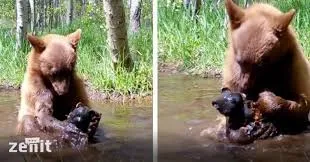
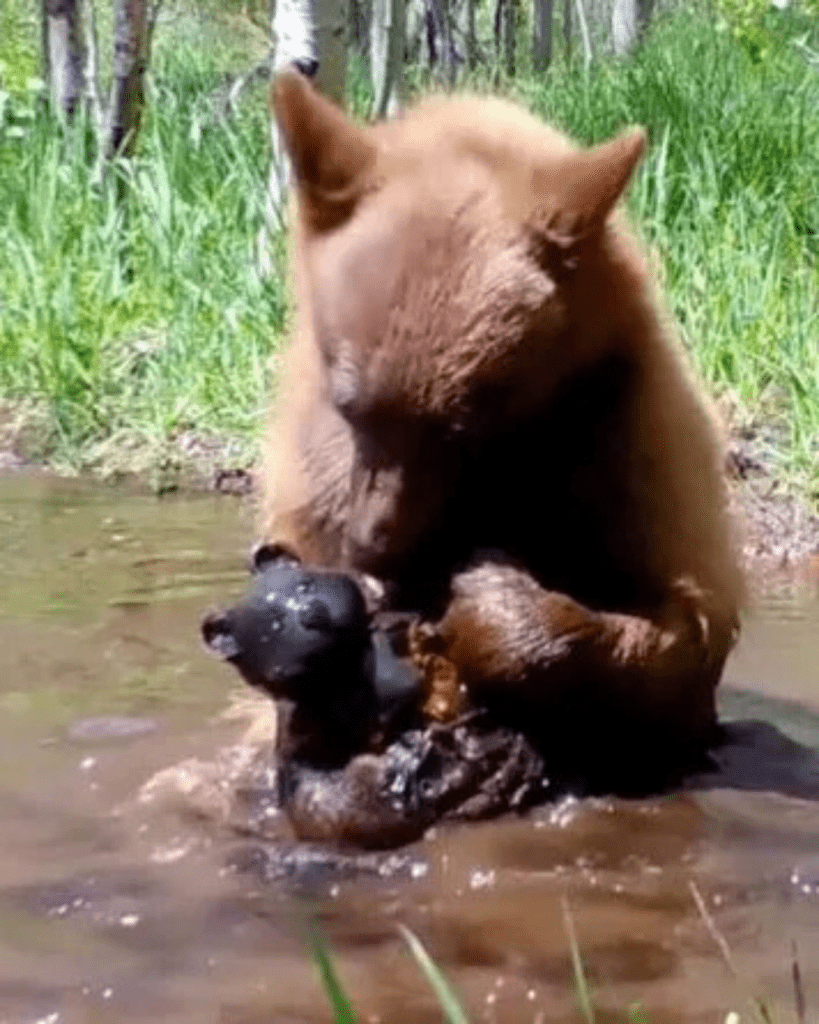
One clip, however, captured hearts across the conservation community. Tamarack had found a stuffed bear toy deep in the forest, likely discarded by humans or carried from a campsite. And there he was, the wild cub, hugging it, tossing it into the air, chasing it like any playful young animal should. Muddy paws and tumbling laughter, all in the quiet solitude of the forest. It was a moment that reminded everyone watching: life can heal, and joy can exist even after devastation.
Tamarack’s story became more than a tale of survival; it became a testament to resilience. He was a living reminder that nature, when given space and care, could mend itself. The forest around him was still scarred by fire, still showing the remnants of devastation, yet Tamarack thrived within it. Streams once blackened by ash were now flowing, vegetation slowly reclaiming burned areas, and Tamarack was part of that rebirth.
For the caretakers who had once held him, seeing him free was both a relief and a revelation. They had feared that captivity was the only life he would know, but Tamarack had proven that even in small bodies, determination could overcome boundaries. He had not just survived—he had returned to the wild on his own terms, and in doing so, he had reclaimed his identity.
His life now follows a rhythm of curiosity and play. He explores, he forages, he rests beneath trees that offer shade and safety. Each day is a lesson in the beauty of independence and the power of instinct. When he tumbles through streams, shakes mud from his fur, or wrestles with a fallen branch, he reminds everyone watching that freedom carries its own form of joy—messy, exuberant, and utterly alive.
Tamarack also serves as a symbol for conservation efforts. His story reminds humans that our presence can both harm and help. Fires, climate change, and encroachment on habitats threaten countless creatures, yet care, intervention, and respect for wildlife can give animals a second chance. Tamarack’s survival is proof that intervention paired with the right kind of release—a chance to return to the wild—can create miracles that benefit both individual animals and the ecosystems they inhabit.
Even now, Tamarack’s adventures continue. Each sighting on the trail cameras sparks a mix of wonder and gratitude among those who followed his journey from burned cub to thriving wild bear. He plays, explores, and lives fully, yet there is a quiet dignity to his life. Tamarack is a reminder that trauma can be overcome, that freedom can be reclaimed, and that joy, even after loss, is possible.
Sometimes, he pauses in a clearing, ears flicking, eyes alert to the forest around him. Other times, he rolls in the mud, paws flailing, the stuffed bear clutched tightly against his chest. He splashes in streams, shakes off the water, and disappears into the underbrush, a fleeting shadow of survival and hope. Each sighting is a small victory, a quiet celebration of life reclaimed, a story that continues to inspire.
Tamarack is not just a bear. He is a testament to the resilience of nature and the possibility of redemption. His journey—from fire to captivity, from fear to freedom—reminds us that even when the odds are stacked, even when the world seems too harsh, life finds a way. And sometimes, it finds a way to play.
Through every muddy paw print and joyful tumble, Tamarack teaches a profound lesson: healing is possible, freedom is precious, and the smallest spark of life, when nurtured, can grow into something extraordinary.
In a forest that once burned and seemed lifeless, a small bear cub now thrives. Tamarack’s life is a living postcard of hope—a reminder that survival is just the beginning, and joy, curiosity, and play can flourish even in the aftermath of devastation.