The sun was dipping low over South Lake Tahoe, its golden light bouncing off rippling water. Beneath the Tallac Bridge, however, beauty gave way to chaos. A 375-pound black bear, sedated and panicked, was thrashing desperately in the frigid current. Each movement sent water spraying, each stroke weaker than the last. The crowd gathered on the shore held its breath, torn between fear and helplessness.
The bear had not meant to be here. Hours earlier, it had wandered from the Sierra Nevada wilderness into a nearby neighborhood, lured by garbage cans and the smell of food. Calls to wildlife authorities had brought officers who worked quickly to contain the situation. A tranquilizer dart was fired—a standard measure to subdue the animal and transport it safely back to the wild.
But tranquilizers are imprecise. Timing is unpredictable. Before the officers could react, the bear staggered away, stumbled down a slope, and toppled into the cold waters of Lake Tahoe. At first, it managed to paddle, massive paws slapping the surface. But then the drug began to take hold. Its movements slowed. Its head dipped lower. With every passing second, the great animal sank further, fighting a losing battle against both sedative and current.
From the bridge and shoreline, onlookers shouted. Some screamed in panic, others urged officers to act. But even the trained wildlife team hesitated—how could they approach a half-sedated, drowning bear without risking their own lives?
It was then that a man stepped forward.
Ivan Stepanov, a visitor from Russia, had been walking near the lake when the commotion drew him in. He was not a local. He was not an officer. He was not equipped with gear or training. Yet as he watched the bear struggle, his instincts spoke louder than caution.
Without a word, Ivan bent down, tugged off his shoes, and peeled away his shirt. His friends shouted after him, warning him of the danger. Bears are powerful even when weak. The water was glacial cold. But Ivan did not hesitate. With one last breath, he dove.
The shock of the water stole his breath, but adrenaline carried him forward. He swam hard, his strokes strong against the pull of the current. Ahead, the bear’s head slipped beneath the surface, bubbles rising in its place. Ivan pushed harder.
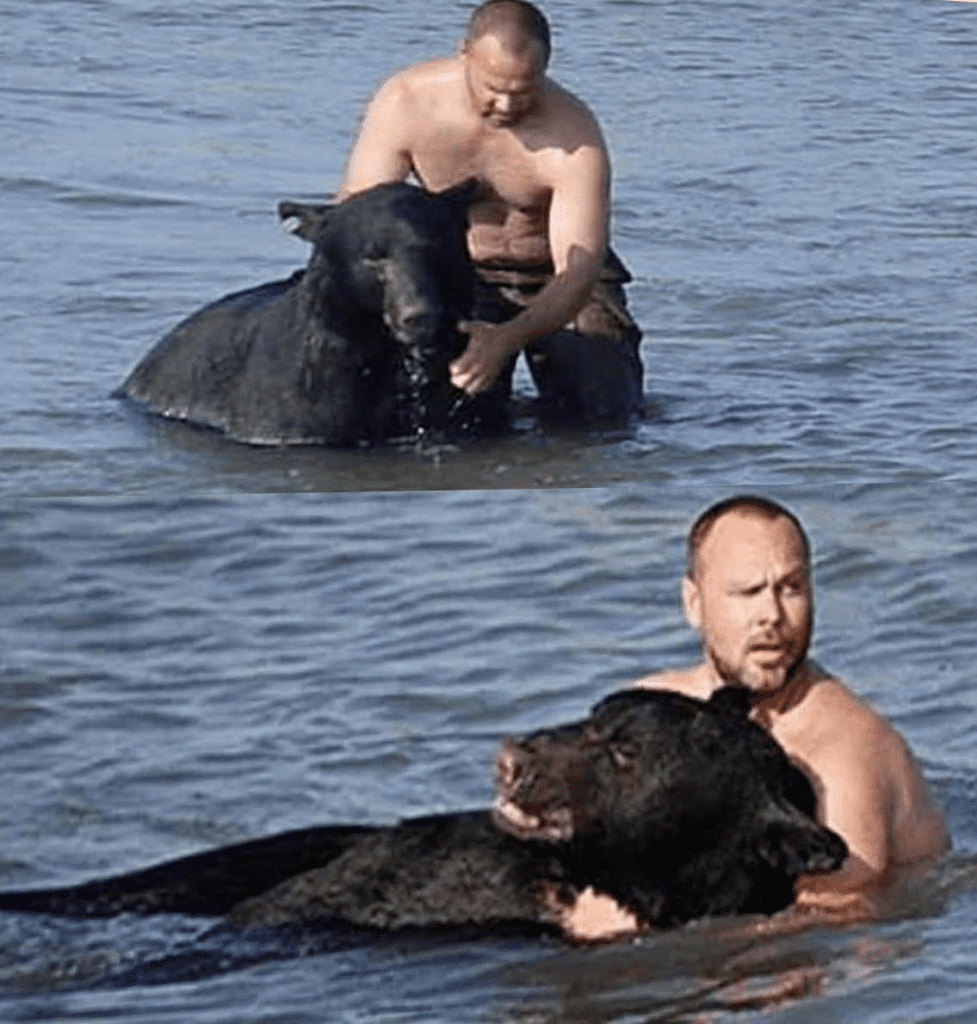
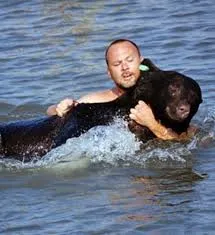
When he reached the animal, he slid his arms beneath its massive neck, straining under the weight. Waterlogged fur clung heavy against his chest. He pulled, fighting to lift its muzzle clear of the surface. The bear coughed, sputtering as air reached its lungs again.
“Spokoyno… spokoyno…” Ivan whispered in Russian, the word meaning calm. He knew the bear couldn’t understand, but his voice was steady, low, a rhythm meant as much to soothe himself as the creature in his arms. The bear’s eyes, glazed and heavy, blinked slowly.
The swim to shore was an eternity. Inch by inch, Ivan kicked and pulled, muscles screaming against the burden. At any moment, the bear might thrash, drag him under, or simply prove too heavy to save. But Ivan did not let go. He whispered, he kicked, he pulled, until finally, the water grew shallower.
Hands reached out from the bank—officers, volunteers, bystanders—all pulling together. With one final heave, the bear’s massive frame was dragged onto the rocky shore.
The crowd erupted in cheers, some clapping, others wiping away tears. Officers rushed forward, moving with efficiency now that the danger had passed. They tagged the bear’s ear for future monitoring, checked its vitals, and ensured the tranquilizer dosage was still safe. Slowly, the animal’s breathing steadied.
Later that evening, as dusk fell, the bear was transported deep into the Sierra Nevada wilderness. Released from the crate, it lumbered forward, pausing only once to glance back before disappearing into the trees.
Back at the bridge, Ivan stood quietly, wringing water from his hair, his chest still heaving with exertion. Reporters who had rushed to the scene surrounded him, asking why he had done it. Why risk his life for an animal with claws, an animal that could have turned on him if not for the sedative coursing through its veins?
Ivan shrugged. His answer was simple, almost matter-of-fact.
“In my country,” he said, “we say a man’s strength is measured by who he chooses to protect—even if it has claws.”
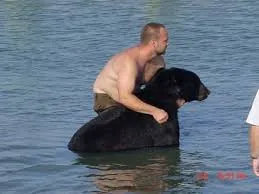
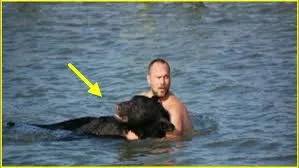
The words spread quickly, carried by those who had witnessed the rescue and by the reporters who could not forget them. Online, photos of the moment circulated: the image of a man in cold, churning water, arms locked beneath the neck of a drowning bear. A sight both surreal and profoundly human.
People marveled. Some praised Ivan’s bravery, others called it reckless. But no one denied the outcome: a life was saved, a bear was free again, and a community had been reminded of the extraordinary lengths compassion can reach.
For Ivan, it was not about heroism. It was about instinct, about the simple belief that strength exists for the sake of protection, not domination. His act that day stood as a quiet challenge to all who heard it: courage is not measured by what we gain, but by what we are willing to risk for another being.
The Tallac Bridge grew quiet again in the days that followed, the lake returning to its peaceful rhythm. But for those who were there, and for the thousands who would later hear the story, the image of a man cradling a drowning bear remains etched in memory. It is a reminder that even when fear paralyzes the many, sometimes one person’s leap of faith can shift the outcome entirely.
And somewhere in the Sierra Nevada, a black bear roams free—alive because one man chose to dive.